Products / Roller blinds
Roller blinds for Bantry Bay’s big glass
The workhorse of the range — a clean fabric panel on an aluminium tube, made to measure for every opening, from a bedroom window to a wide sliding wall onto the terrace.
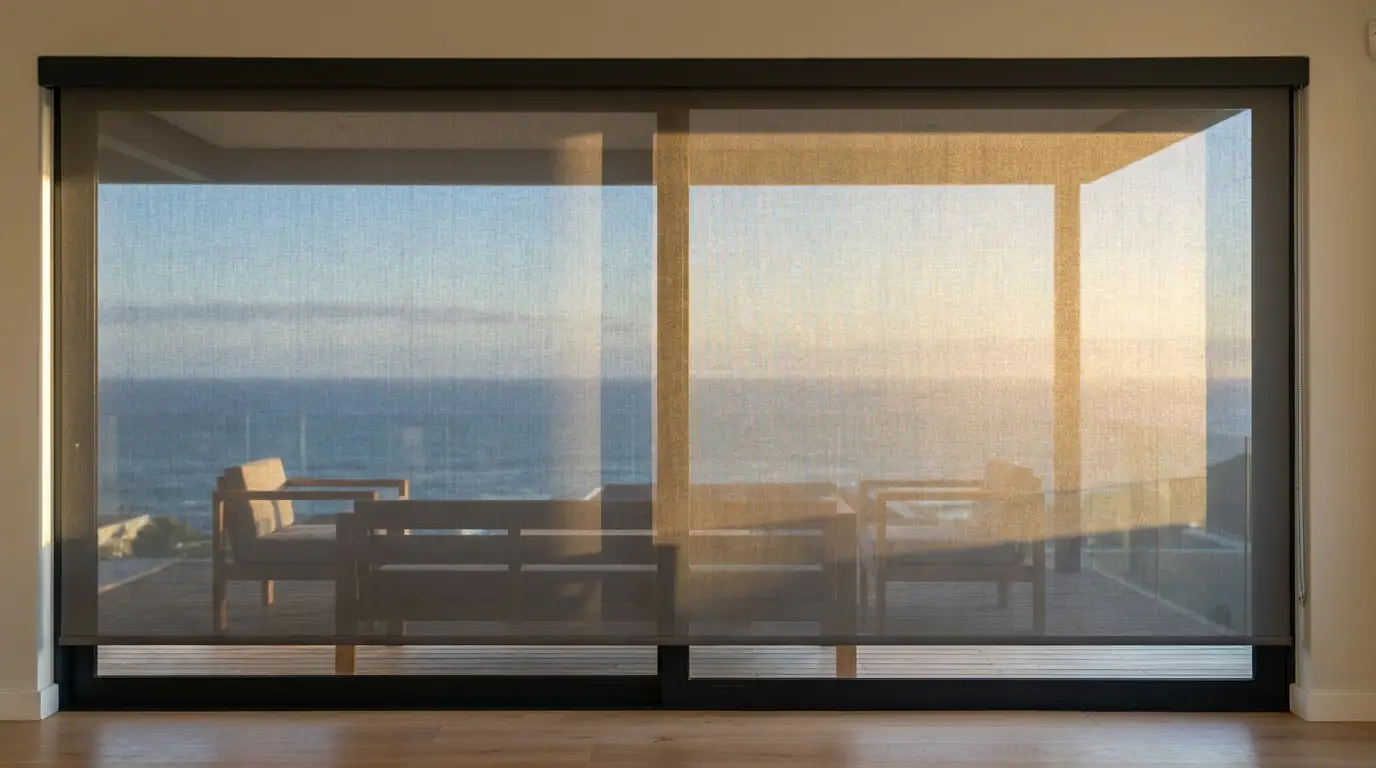
Roller blinds are the most common blind fitted along this stretch of the Atlantic seaboard, and for good reason — they suit almost any room, they’re easy to keep clean, and the fabric choice does most of the work. The real question on a Bantry Bay terrace is rarely “roller or not,” it’s which fabric, and whether one blind is enough for glass that spends half the day facing straight into the sunset.
Fabric — the decision that matters
- Blockout — total light stop, for bedrooms, nurseries and media rooms. It also acts as an extra insulating layer, useful on the large single panes many Bantry Bay apartments are built around.
- Sunscreen (3–10% openness) — a mesh weave that cuts glare and UV while keeping the view out. Lower openness blocks more heat and glare but shows less view; 3–5% is the standard choice for view-preserving sun control on west-facing panes here. Note the trade-off: sunscreen gives daytime privacy, but reverses at night once the lights are on inside.
- Light-filtering / translucent — softens the light and gives full privacy without full blockout, a middle ground for living areas.
Double roller (day/night combo)
A blockout and a sunscreen fabric on one bracket is the practical answer for a bedroom that also has a sea view worth keeping — sunscreen up during the day, blockout down at night, without two separate blinds fighting for the same window.
Fit, finish and salt air
Chain control needs a wall tensioner as standard practice for child safety; spring-assist and motorised options are both available, and motorisation removes the chain question entirely. Because the swell breaks close beneath this cliff, we specify powder-coated aluminium tubes and brackets as standard rather than an upgrade — cheap hardware corrodes fast this close to the water. Single blinds run to roughly 3m of fabric width before a join line or a linked, motorised pair becomes the better answer.
What a roller costs here, by the square metre
A roller driven by chain or spring, in blockout cloth, sunscreen mesh or a translucent weave, runs from about R1,000 to R1,600 per square metre installed. Ordinary blockout takes the bottom of that band; a fine-weave sunscreen; a tight-openness sunscreen for west-facing glass, or a twin bracket holding both a mesh and a solid cloth, sits at the upper. Motorised, allow R2,500 to R3,800 per square metre, which covers the tube motor, the control and the setup on fitting day.
Read them as planning bands rather than a quote. A small window carries a minimum charge, since the brackets, tube and fitting time hardly reduce with the opening, and the price for each of your windows is settled after the free measure and given to you in writing.
Let’s measure your windows properly.
You get the measure free, a quote in writing for every window, and an honest no if roller isn’t right for that opening.