Bantry Bay Blinds / The free guide
The Warm Side of Lion’s Head
Bantry Bay is the pocket of this coast that gets the least wind — which is exactly why it gets the most heat. A free, honest guide to the four ways warmth arrives in a Kloof Road apartment, and what actually stops each one.

Take this guide with you as a PDF — 14 pages, 1.4 MB, everything on this page.
Before the four
Shelter is not a free lunch
Every property listing on this cliff sells the same line: Bantry Bay is the sheltered one. Tucked under Lion’s Head, out of the worst of the south-easter that hammers Camps Bay and Clifton around the shoulder of the mountain, warm when the rest of the seaboard is bracing. It is a fair description, and it is also the reason so many people here are uncomfortable by four in the afternoon.
Wind is a cooling mechanism. It moves warm air off a glass facade, drags heat out of a terrace, and takes the edge off a west-facing room the moment it picks up. Take the wind away and leave everything else in place — a west and north-west aspect, open water throwing light back at you, a rock face that has been absorbing sun since ten in the morning — and you have a suburb that holds its heat far longer into the evening than the exposed stretches either side of it.
So this guide is not organised by room or by compass point. It is organised by where the heat is coming from, because on this particular cliff there are four separate routes and they want four different answers. Everything factual below is sourced, and the list is at the foot of the page.
Straight through the pane
The obvious one, and the biggest. Cape Town lies at about −33.93° latitude. At the December solstice the sun is around 80° up at solar noon and sets at an azimuth close to 240° — south of due west, so the last and lowest light of a Bantry Bay summer evening arrives from the south-west quarter, not from straight ahead.1 By the June solstice noon is down to roughly 33°, due north, and sunset has swung round to about 297°.1
Two things follow. First, the balcony slab above your window — the thing that makes a stacked Kloof Road building work — handles the December midday sun beautifully and does almost nothing at six in the evening, because by then the light is coming in from underneath it. Second, the load is real, not just uncomfortable: the summer UV index here averages about 12 in November and peaks near 14 in December, well inside the “extreme” band that begins at 11.2 That is what fades a rug and a timber floor over a couple of summers.
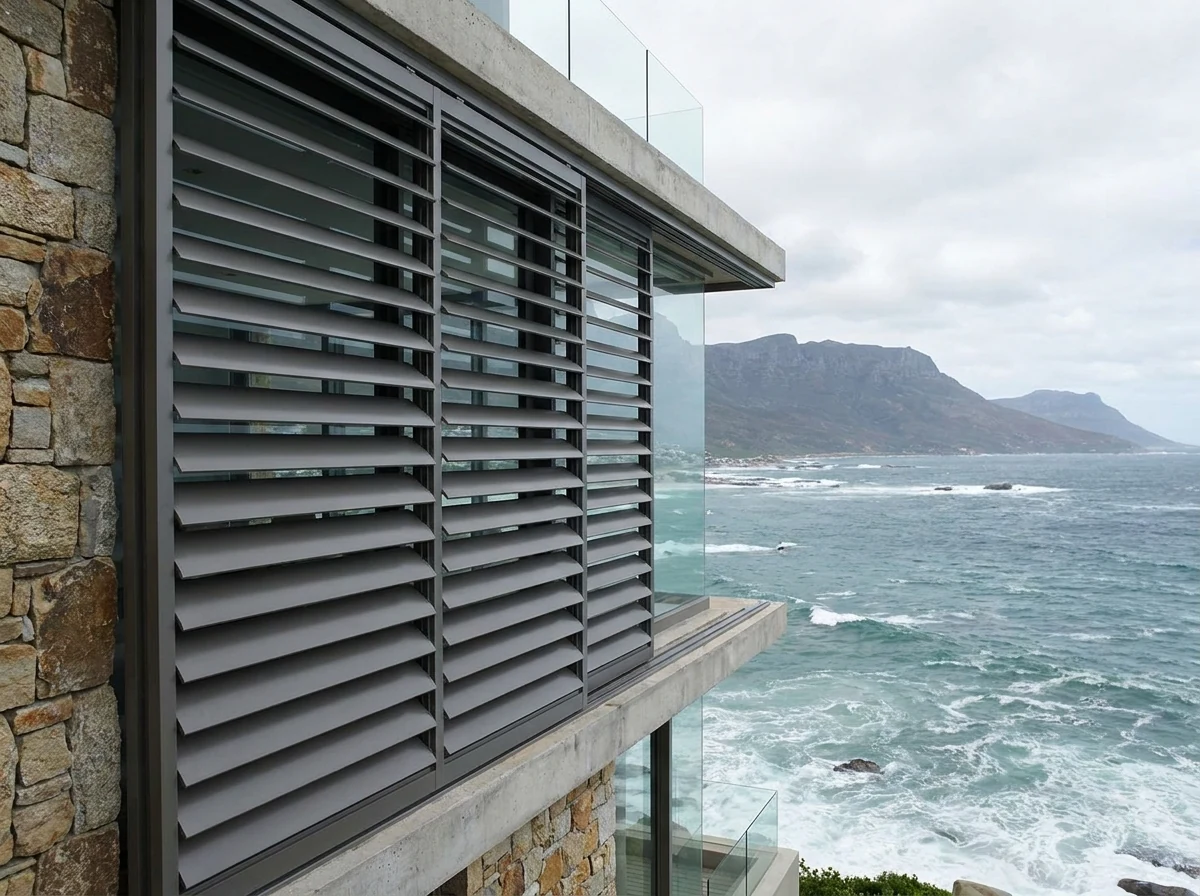
Only something on the outside of the glass genuinely stops this route: external venetian slats, an external roller shutter, or a zip screen across the opening. All three intercept the energy before the pane warms up at all. An interior blockout is not a heat solution — the pane still gains, the fabric absorbs it, and both then radiate into the room behind. It is the correct answer for darkness; it is the wrong answer for heat.
Bounced up off the water
Bantry Bay does not sit beside the sea, it sits above it. From most units on this stretch the ocean is below the sight line rather than level with it, and open water reflects a meaningful share of the light that lands on it — more, not less, as the sun drops toward the horizon and the angle flattens.
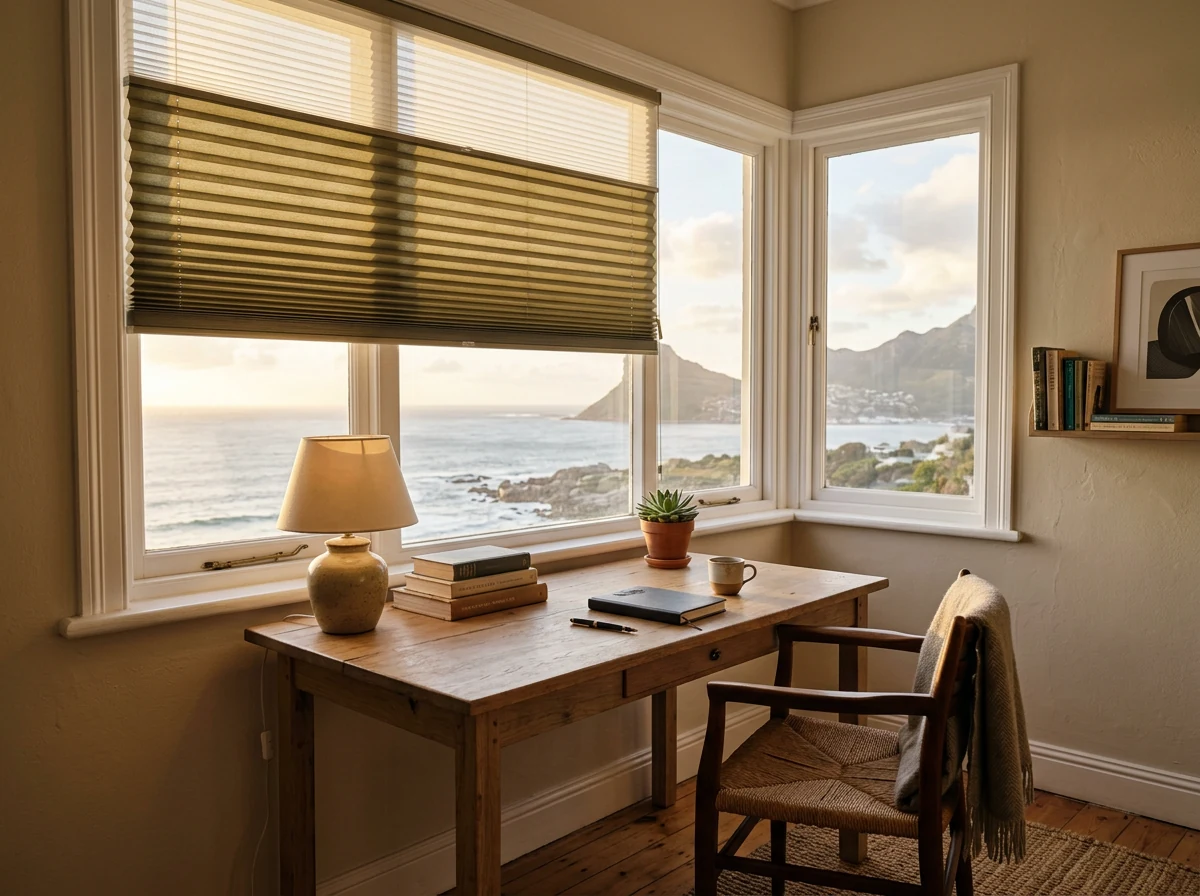
That produces something you rarely have to think about inland: a second helping of afternoon light arriving from below the window, lighting the ceiling, the tops of the walls and the upper half of a room that a normal top-down blind has already covered. It is why people describe the glare here as impossible to place — you pull the blind down to the sill line and the room is still too bright.
Anything that treats the whole opening rather than the top of it. A sunscreen mesh taken to the full drop, a bottom-up option where the lower half is the problem, or aluminium venetian slats tilted upward so they throw the reflected light back out rather than scooping it into the ceiling. Slat direction is not a detail on this cliff — on a window looking down onto water it is most of the answer.

Given back by the stone
The third route is the one nobody quotes for. Bantry Bay is built on and against rock, and the buildings themselves are heavy: masonry, concrete slabs, paved terraces, retaining walls, boulders. All of it absorbs solar energy through the day and releases it slowly once the sun is off it. That is ordinary thermal mass behaving normally — it is also why a terrace on this cliff can still be noticeably warm at nine o’clock on a February night, long after the sun has gone.
It is a genuinely different problem from glare, because it arrives when there is no sun left to block, and no blind can shade a wall that is already warm. What you can do is stop the wall and the slab getting there in the first place, and keep the stored heat that is already in the fabric from radiating straight into the living space.
Shading the surface, not the eye. An awning or a screen that keeps the sun off the paving and the parapet through the afternoon means there is less stored energy to give back after dark. Inside, a cellular honeycomb blind is the one fabric that genuinely helps: the trapped air in the cells slows heat moving through the glass in either direction — useful against an evening that will not cool, and equally useful in July when the same room runs cold.
The cooling you don’t get
The fourth route is a subtraction rather than an addition, and it is the one that makes this suburb specific. The south-easter Capetonians call the Cape Doctor blows mainly from about October to March, funnelled and accelerated by the mountains around the city, with gusts measured up to roughly 160 km/h over Table Bay.3 Around the shoulder of the mountain at Camps Bay and Clifton, that wind is a nuisance for an awning and a blessing for a hot room. In Bantry Bay’s lee it is reliably weaker — which is precisely why the same afternoon feels hotter here than it does one bay along.
Sheltered is not the same as still, and we will not pretend otherwise: on the upper terraces, and on the exposed corners of the higher blocks, the wind absolutely finds you, and it arrives without much warning. Winter then flips the whole picture, with north-westerly fronts coming in off open water through a season that carries roughly 70% of Cape Town’s annual rainfall between June and September.4
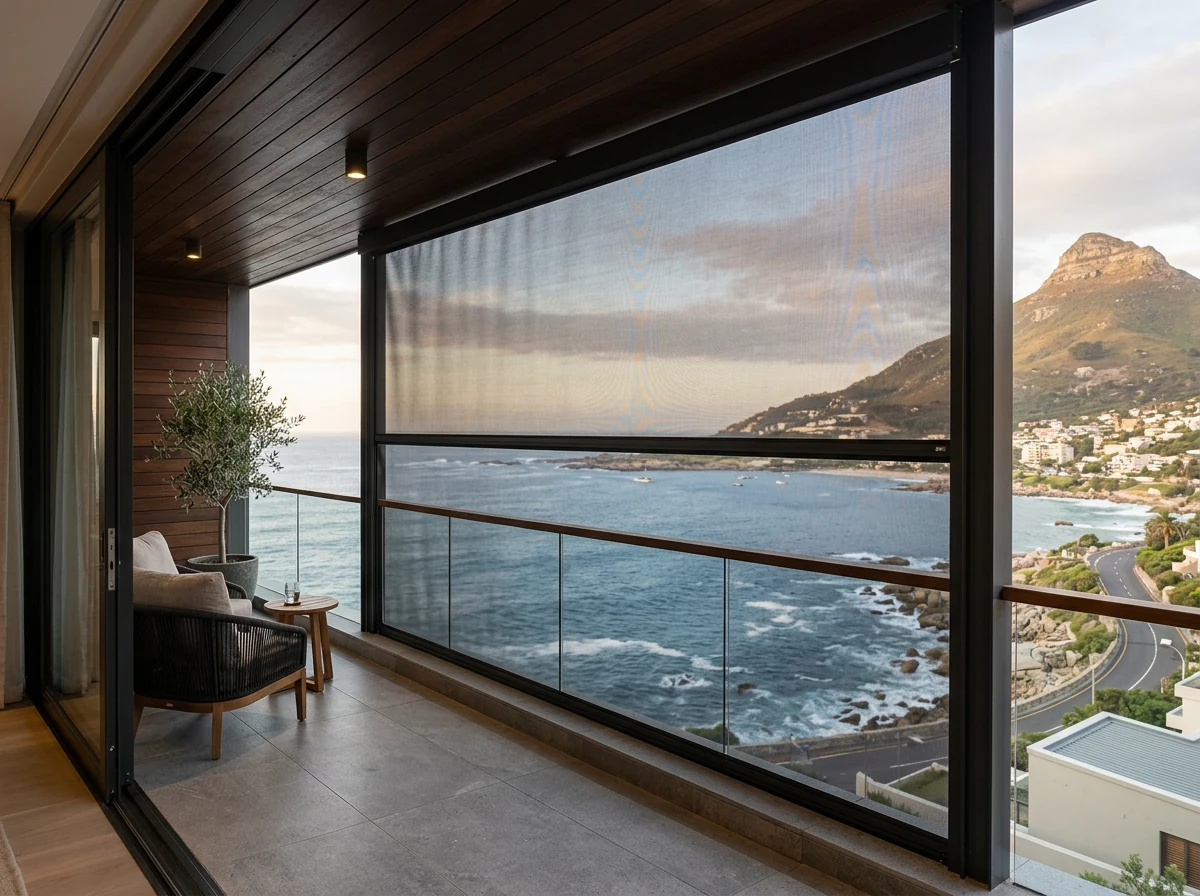
Two things. Ventilation becomes part of the shading conversation, not separate from it — a screen that lets you leave a door open on a still evening is worth more here than in a windy suburb. And on the exposed upper levels, anything outside is specified wind-rated and, ideally, sensor-retracted: a zip screen held in side channels for the corners that catch it, a folding-arm awning where the position is genuinely sheltered.
Where you are on the cliff
The same four routes, weighted differently by level
Kloof Road’s blocks step down the rock in stacked terraces, and the mix changes as you go up. This is a rough guide, not a rule — your own building decides it.
Lower levels
Often partly shaded by the terrace above and by the road embankment behind. Stored heat from paving and retaining walls dominates; glare is usually the smaller half of the problem, and privacy from the walkways above is often the larger one.
Middle levels
The purest sun-trap. Nothing overhead to help after four o’clock, water below the sight line throwing light back up, and still enough shelter that the wind does not carry the heat away. This is where external shading earns its cost fastest.
Top level & roof terrace
Everything the middle levels get, plus a roof taking sun all day and the one position on the block where the south-easter genuinely arrives. Wind rating and automatic retraction stop being optional here.
Two constants
Whatever the route, these two apply
Salt decides your hardware. The swell breaks close beneath this cliff and the air carries it. Untreated fixings pit and chain mechanisms stiffen; powder-coated aluminium and sealed cassettes are the baseline outside, not an upgrade. We will not call any of it maintenance-free — this close to the water, an occasional rinse with fresh water is part of owning it.
The trustees decide your exterior. Most buildings on this stretch are sectional title, and the face of the building is not yours alone. Anything fixed outside the glass line — a headbox, a set of guide channels, an awning cassette — is likely to need the body corporate’s sign-off, usually over colour and over what shows from Kloof Road. We will supply the spec sheet that application needs. We will not tell you it is a formality, and we will not submit it for you.
The suburb everyone calls sheltered is the suburb that keeps its heat — and a blind that only fixes glare fixes about a quarter of the problem.Why we walk the whole flat before quoting
What people ask after reading this
If external shading is that much better, why fit anything inside at all?
Because heat is only one of four jobs. Darkness for sleeping, privacy after dark, softening the light without losing the view, and insulation on a cold July morning are all interior jobs, and external shading does none of them well. Most flats here end up with something outside on the worst one or two elevations and something inside everywhere else.
My blind is fully down and the room is still bright. What have I got wrong?
Almost always route two — light coming up off the water and landing on the ceiling. The fix is rarely a darker fabric; it is covering the lower half of the opening, or tilting slats upward so the reflection goes back out instead of being scooped in.
Are your roller shutters a security product?
No, and we would rather be plain about it. Ours are shading shutters: rigid aluminium slats rolling down outside the glass to stop sun, heat, glare and light. Security-rated shutters are a different product with a different frame and fixing, quoted separately on request.
Will the body corporate really care about a blind?
About an interior blind, usually not, beyond the backing colour that shows through the glass in some schemes. About anything fixed to the outside of the building — a headbox, guide channels, an awning cassette — usually yes. Ask your trustees before you order, not after.
Does motorisation actually matter, or is it a luxury?
On a wide glass wall three floors up a cliff it is mostly a practical question about ladders and reach. It also makes a sun or wind sensor possible, which is the only way exterior shading protects itself when nobody is home — the relevant scenario for the many part-time homes on this stretch.
Tell us which route is bothering you
Send this and one of our expert consultants will contact you shortly to arrange your free in-home measure — every opening measured, samples in hand, and a written per-window quote afterwards.
Where the numbers come from
Latitude, solar altitudes and azimuths, the UV index, the wind and the rainfall split are all sourced below. Where a figure reaches us through an aggregator rather than a primary weather-station record, we say so instead of dressing it up.
- Gaisma — Cape Town sun and moon data (latitude −33.93°; December-solstice altitude at 12:00 about 75°, sunset azimuth 240°; June-solstice altitude at 12:00 about 31° due north, sunset azimuth about 297°). Altitudes quoted on this page are calculated for true solar noon from the latitude and the ±23.44° declination — the source's readings above are taken at 12:00.
- Nomadseason — Cape Town UV index (November average around 12, December around 14; the “extreme” band starts at 11). Aggregator source, not a primary measurement record.
- Cape Town Magazine — The Cape Doctor (summer south-easter, roughly October to March; funnelling and acceleration around the mountains; gusts measured up to about 160 km/h over Table Bay).
- South Africa Gateway — South Africa's weather and climate (Cape Town's Mediterranean, winter-rainfall pattern; roughly 70% of annual rainfall between June and September).
Bantry Bay’s reputation as one of the more wind-sheltered pockets of the Atlantic Seaboard is a widely repeated local description of its position in the lee of Lion’s Head, not a measurement we are quoting from a weather station — treat it as the useful rule of thumb it is. The four routes, the level notes and every product recommendation here are our own opinion, offered free and without obligation, and nothing on this page is a body-corporate or planning opinion.
Let’s find out which route your room is actually taking.
Free in-home measure, a written per-window quote, and hardware specified for salt from day one.